NEWS

Latest documentary "Oyster Factory" has been officially invited to Locarno International Film Festival 2015! 最新作『牡蠣工場』がロカルノ国際映画祭へ正式招待されました!
Showing posts with label English Articles. Show all posts

Wednesday, November 28, 2012

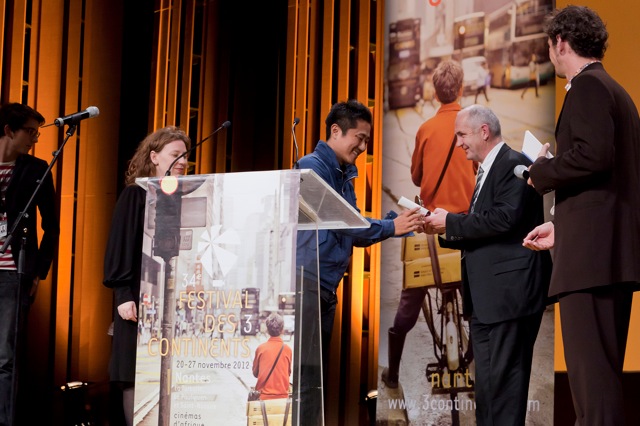
Theatre 1&2 won the Young Jury's prize in Nantes 『演劇1・2』、ナントで「若い審査員賞」受賞!

Photo by Festival des 3 Continents

Photo by Festival des 3 Continents

Photo by Festival des 3 Continents

photo by Sayaka Atlan


Theatre 1 & 2 won the Young Jury's Prize at the Festival des 3 Continents in Nantes, France. Young jury is composed of film lovers aged 18-25. The festival is known for the fact that they discovered such talents like Hou Hsiao-Hsien and Kiarostami.

【2012年度(第34回)ナント三大陸映画祭】コンペティション部門にて、『演劇1』『演劇2』が「若い審査員賞」を受賞いたしました。「若い審査員賞」は、映画を学んでいる学生シネフィルを中心とした、18歳から23歳の7人で構成される審査員団によって選ばれる賞です。ナント三大陸映画祭は、ホウ・シャオ・シェンやキアロスタミを見出したことなどで知られています。

僕のコメント「若い世代の映画離れが進むのを年々目の当たりにしつつ、一人の映画を愛する者としてなんとかしなければ、と思っていた矢先の「若い審査員賞」受賞なので、本当に嬉しいです。最近の若者は集中力が続かないなんて、誰が言ったのでしょうか(笑)。作り手が本気で作ったものは、若い世代にも本気で受け止めてもらえる証拠だと解釈しました。これからも容赦せず、力いっぱいの豪速球を投げつづけたいと思います」

Friday, June 17, 2011

Peace in Tokyo

『Peace』の東京・渋谷のシアターイメージフォーラムでの上映時間が決定。7月16日(土)から1日5回上映です。
11:15(日本語字幕版)/13:15/15:15/17:15/19:15(英語字幕版)。

The screening schedule at Theater Image Forum in Shibuya, Tokyo has been set at :

11:15 (w/Japanese subtitles)/13:15/15:15/17:15/19:15(w/English subtitles).

5 times everyday starting from Saturday July 16th!

http://www.imageforum.co.jp/theatre/

Tuesday, June 07, 2011

See you in UK!

I'm leaving for the UK tonight!

I'll speak about documentary filmmaking on June 10 at 18:30 @Japan Foundation in London. Admission Free.
http://bit.ly/jfy0yQ

PEACE will be screened at Sheff Doc/Fest on June 12 at 10:30 AM as UK premiere.
http://bit.ly/lGklCp

See you there!

Sunday, June 05, 2011

新書の校正中!My new book in progress!


7月15日刊行予定の書き下ろし新書『なぜ僕はドキュメンタリーを撮るのか(仮)』(講談社現代新書)のゲラです。いわゆる著者校正、ほぼ完了しました。

A galley for my new book THE REASON WHY I MAKE DOCUMENTARIES to be published on July 15th from Kodansha.

Wednesday, December 01, 2010

ガンとねずみ Gan and Mouse

 足利の実家で猫たちを眺めていたら、独眼竜ガンちゃんがなんとネズミをくわえてきたので思わず激写。ネズミさん、ごめんなさい。でも猫の本能はどうしようもないんだな…。


As I was seeing my parent's cats in Ashikaga, one of them, one-eyed Gan-chan captured a mouse. I feel sorry for the mouse, but we can do nothing about the cats' nature....


Tuesday, November 16, 2010

Review of PEACE by Robert Koehler, Film Comment

...a quality clearly on display in Kazuhiro Soda's lovely, handmade Peace. On the surface, this is a story about caregivers, specifically the husband-and-wife team Toshio and Hiroko, who provide services for the elderly and infirm in their Tokyo prefecture. But as Soda's camera casually observes his subjects, the lack of insistence upon a central theme frees the film to become about everything: from the behavior of a group of stray cats Toshio cares for, to the ways in which certain Tokyo alleys grow dark and forbidding as night sets in. This type of cinematic freedom is embedded in today's growing movement for more observational documentaries—think ofSweetgrass or Foreign Parts—and, with it, Soda has developed into one of the discipline's most interesting, and freest, artists.
by Robert Koehler, Film Comment

http://www.filmlinc.com/fcm/nd10/vancouver.htm

Interview on PEACE by Barbara Stowe

Interview on PEACE by Barbara Stowe on The Bulletin.


At a Q and A at the Pacific Cinemateque following a screening of “Peace” the night before this interview, Soda Kazuhiro explained that this documentary was commissioned by a Korean border town for a film festival on the topic of peace and coexistence. He almost turned down the commission because he usually works without a premise in mind, finding his thematic thread only later, in the editing room. What began as a short turned into a 75-minute feature that has been well received in Korea, Japan and by the VIFF audience.
What was the name of the town that commissioned the film?
Paju. It’s a border city, between North Korea and South Korea, and it’s right next to the DMZ—the demilitarized zone—which is two km wide along the borderline. That’s where the film festival takes place. Obviously it’s kind of symbolic to have a film festival there with the theme of peace and coexistence, so for them to screen the film they commissioned was kind of a big deal. They were very passionate about it.
Part of this town is in North Korea and part in South?
The town itself belongs to the south. But it’s right at the border between North and South Korea. You feel the tension because the riverbank is all wired up—(here Kazuhiro made a circular gesture, indicating barbed wire)—and there are many military personnel walking around…The opening of the festival was planned to be held at the Freedom Bridge which connects North and South Korea and there were many soldiers protecting the events when we arrived.
Why do you think they chose you to make the film?
I have no idea. I don’t know why they picked me. I’ve done…my previous film, it’s called “Mental”, it premiered in Pusan in 2008 and it won the best documentary award there. That’s probably one of the reasons.
Does the Japanese word for “peace” translate into exactly the same meaning as the English word or are there differences?
Ahh…it’s almost the same I think. It’s funny, usually words have…I mean, they overlap but not exactly, but peace and “heiwa”, I don’t see too much difference.
Taking peace as a subject inherently promises an exploration of conflict resolution. Within the cat society there was a clearly defined conflict and a neat resolution, but within the human society there was no simple resolution. I’m wondering if that was part of your message, that society’s care of its most vulnerable members is a difficult matter without any easy answers?
In terms of message I don’t have any message to convey. My films…if I want to convey a message I wouldn’t make a film, I would probably write an essay because it’s much easier. For me, film is a way to depict the way I see the world and especially when I’m making documentaries I try to recreate my experience…I see some people, I witness some events, I hear stories…that kind of personal experience I can recreate in a cinematic reality and it can include some sort of atmosphere like light or darkness or silence between dialogue…all kinds of life experience you can translate easily…well, it’s not easy but you can translate somehow into cinematic experience. It’s up to the audience what kind of message they take…I mean, it’s not a message, what kind of interpretation they take from the experience they have with the film. So I really don’t have a particular message to convey. But I have my own interpretation, which is not the ultimate interpretation to the film, it’s one interpretation and each viewer is entitled to his or her own interpretation.
Tell me more about your own interpretation.
Okay. When I was looking at the cat society I thought it was much simpler. For example, in the human society if somebody outside is coming into the community there are so many obstacles to clear, for example borders or laws. Even if you want to accept somebody there are things you need to deal with. Humans have egos and that kind of thing gets in the way even if you want to make peace with somebody, right? But in the cat society I thought it was much simpler. And I thought my father-in-law’s interpretation of the way cats live together was so inspiring. He told me in the film that his cats are disappearing one by one and he thinks that cats are kind of giving away their spot to younger and weaker cats. The strong ones are yielding their spot to younger and weaker cats. That is his point of view and his interpretation and I don’t really know if it’s true to the cats but I thought it was very interesting, and it kind of echoed the fact that  Mr Hashimoto was almost at the exit of his life, and he was leaving the world, which it made me think about why we die. We see dying as kind of a negative thing but if we don’t die probably this world is so overpopulated with human beings so I think dying is one way of giving away your spot to the next generation, meaning you are coexisting…it is necessary for you to die for you to coexist with the next generation. It made me think about the subject and I thought it was important to make them parallel, the story of the cats and the story of the people in the film.
I think you just answered my next question.
(Kazuhiro laughed.)
With your portrayal of the compassion of the caregivers, were you saying that how a society cares for its most vulnerable members is a measure of the compassion of that society, and that compassion is the basis of a lasting peace?
I think so. It does have a lot to do with it I think (compassion), and also not only people, but animals. I travel a lot and if I go to a city where I see a lot of stray cats on the street and if I witness these cats living peacefully and alive I feel, oh, this is a good city because they’re not being pushed by human people, they’re being allowed to live in their spot. And they are the most vulnerable in a sense. If they are around it means the city has some tolerance, and people there are somewhat allowing the feral beings to live. So it is a major…when you have stray cats in the city it tells me if the city is civilized or…I mean usually if you see lots of stray cats you think the society is not civil, but I think it’s the opposite. And also, people with disabilities and the elderly, if they have their spot, their niche in society it means that the society is cherishing everybody’s needs and so it is almost like…I mean, it is probably the basis for peace. Because the war…you know, it’s like  Mr Hashimoto was talking about, all the individuality is lost…you can get drafted for 1.5 sen, for the price of a postcard you can be drafted and get killed. In order to do a war you need…the society needs to shift that way…I think if the society cherishes everybody’s needs and reasons to live or everybody’s rights or whatever than you cannot really fight any war. It’s impossible, right? It’s impossible, because in order to fight a war with another country you need a lot of people who are like robots, who are willing to sacrifice themselves for the war.
You say you don’t have a message, but this is activist talk.
(Laughs.) It’s just my interpretation. It’s something I discovered while making the film.
Would you say more about the history of Peace cigarettes?
After World War II the Japanese government started selling tobacco and the first brand of cigarettes they sold was Peace. Japanese people were fed up with war. I was kind of thrilled that  Mr Hashimoto had been smoking Peace cigarettes ever since the war because if feels like a metaphor of post-war Japan. It gave the film another layer.
http://jccabulletin-geppo.ca/featured/vancouver-international-film-festival-interviews/

Friday, September 17, 2010

『PEACE』、東京フィルメックス・コンペ部門に招待決定 PEACE invited to competition of Tokyo Filmex

『PEACE』が2010年・東京フィルメックス映画祭のコンペティション部門へ招待されることになり、昨日、記者会見に出席しました。

映画ファンなら鼻血が出そうなプログラムで、期間中は自分の映画そっちのけでヒトの映画ばっかり見続けるんじゃないかな、こりゃ。ホウ・シャオシェンやキアロスタミも来日するらしい。特にキアロスタミは僕にとっては神のごとき監督。お会いできるのが楽しみです。

それにしても恐るべし、林&市山コンビ。


PEACE is now invited to the competition section of Tokyo Filmex 2010, so I attended a press conference yesterday. 

The program is amazingly packed with movies I wanna see, so I guess I'll probably end up seeing other people's movies during the festival. And I can't believe Hou Hsiao Hsien and Kiarostami are coming! Especially Kiarostami is like a living god to me. I'm so looking forward to meeting them.

Such a marvelous job, Ms. Hayashi and Mr. Ichiyama!

Saturday, September 04, 2010

PEACE to be invited to VIFF バンクーバー国際映画祭に招待決定


PEACE is now invited to Vancouver International Film Festival to be held September 30 -October 15, 2010. I'll be there in early October to do Q&A sessions. Dates and details to be announced later.

新作『PEACE』がバンクーバー国際映画祭に招待されることが決まりました。映画祭の開催期間は2010年9月30日から10月15日まで。僕は10月初めにバンクーバー入りして、上映に出席します。詳細は後日。

http://www.viff.org/

Tuesday, August 10, 2010

PEACE to Open the DMZ Docs Festival!


I'm very happy to announce that my new documentary PEACE has been selected to open the DMZ Korean International Documentary Festival. The screening will take place in the evening of September 9th, 2010, which will be the film's world-premiere. The screening with Q&A will be at 18:00 on September 11th.

http://english.yonhapnews.co.kr/culturesports/2010/08/10/0701000000AEN20100810008700315.HTML


新作『PEACE』が韓国・非武装地帯国際ドキュメンタリー映画祭のオープニング作品に選ばれました。上映は9月9日の20時ごろ!それが本作のワールド・プレミアになります。9月11日の18時からは質疑応答付きの上映があります。

http://japanese.yonhapnews.co.kr/society/2010/08/10/0800000000AJP20100810003700882.HTML

Saturday, July 31, 2010

PEACE Official Web 『PEACE』公式サイト

The official website of PEACE is now online.
『PEACE』公式サイトができました。

英語 English: http://www.laboratoryx.us/peace

日本語 Japanese: http://www.laboratoryx.us/peacejp

Thursday, July 29, 2010

PEACE trailer 予告篇

予告篇作りました。結構音楽で盛り上げてますが(笑)、本編には音楽無しです。

I just made a trailer. In the movie itself, I didn't use any music.

Friday, July 23, 2010

Director's Statement on PEACE


by Kazuhiro Soda

In the summer of 2009, the DMZ Korean International Documentary Festival in the border city of Paju, South Korea, asked me to make a 20 minute-short documentary about peace and coexistence. But honestly, I wasn’t so keen on the idea at first.

One reason is that I firmly believed I should never set up a theme before I make a documentary. Otherwise, there is a danger that the theme becomes more important than the reality itself, and would dictate my filmmaking process. I would shoot materials that might fit to the theme rather than learn from what I see. I believed that the theme should be discovered only after the long process of observation of the world through shooting and editing.

I was also hesitant to deal with such a big theme as peace and coexistence, which sounds too politically correct and can be perceived as almost cliché. I was saying to myself, “There’s no question that everybody wants peace and coexistence. Why should I make a movie about such an obvious theme?”

I was about to decline the offer.

However, in the fall of the same year, I suddenly changed my mind. While I was casually videotaping Toshio Kashiwagi, my father-in-law, feeding some stray cats in his neighborhood in Okayama, Japan, I got an idea for the movie. He was feeding a peaceful community of stray cats, but the situation became shaky because a male “thief cat” from outside was trying to invade their territory. It reminded me of the problems we human beings have, and I was convinced that I could make a short documentary about the issues of coexistence among cats.

But, while shooting the relationship between my father-in-law and his cats, I also became interested in his work as a welfare taxi driver, and the way he deals with his clients. Through him, I further got acquainted with Shiro Hashimoto, a 91-year-old gentleman who was contemplating his own death. This made me curious about the work of Hiroko Kashiwagi, my mother-in-law, who was taking care of Hashimoto. While shooting all these scenes that attracted me, it became apparent that a 20-minute short documentary was turning into a feature.

While I was shooting this film, there was one thing I constantly reminded myself; the theme of peace and coexistence should only serve as a starting point. What is most important is to explore the cinematic journey without being bound to where I began.

So, I decided to shoot whatever interested me, even if it seemed to have no relation to the theme. The scenes of Hashimoto are the typical examples. In fact, if I were only concerned with the theme, I wouldn’t have shot any of them.

Just like in my other observational documentaries, I prohibited myself from doing any research or meeting prior to shooting to avoid having preconceptions. During the editing, I put aside the theme, and tried to make discoveries by accumulating scenes that interested me. In this sense, I practiced my usual observational method of filmmaking.

However, it’s wrong to say that I was not influenced from the theme I tried to forget. In fact, throughout the filmmaking process, I found myself constantly thinking about these questions: What is peace? What is coexistence? How can they be realized, and how can they be destroyed? And I believe that the finished film asks the same questions to the audience, too. The film also explores the meaning of Japan’s post-war era and its future, thanks to Hashimoto’s unexpected war stories and his favorite cigarette brand “Peace,” a long-selling tobacco that came out in January 1946 right after Japan’s defeat in WWII.

PEACE synopsis


What is peace? What is coexistence? And what are the bases for them?

PEACE is a visual-essay-like observational documentary, which contemplates these questions by observing the daily lives of people and cats in Okayama city, Japan, where life and death, acceptance and rejection are intermingled.

Three people and stray cats are the main characters.

Toshio Kashiwagi runs an affordable taxi service for the disabled and the elderly, having retired as a principal at a special school. Meanwhile, he feeds a group of stray cats everyday. However, there is a growing tension in the cats’ peaceful community because a male “thief cat,” an outsider, is trying to invade it.

Toshio’s wife, Hiroko Kashiwagi, runs a non-profit organization, which sends home helpers to houses of the elderly and the disabled. But, her organization is facing financial difficulties because of budget cuts from the government. At home, she has been grumbling about the way Toshio feeds his cats.

As a professional caregiver herself, Hiroko regularly visits 91-year-old Shiro Hashimoto to help his daily routines. Living in a mice and tick infected small apartment, Hashimoto is spending his final days thinking about his own death. His memories of being drafted to World War II come back to him while dealing with Hiroko.

Thursday, July 22, 2010

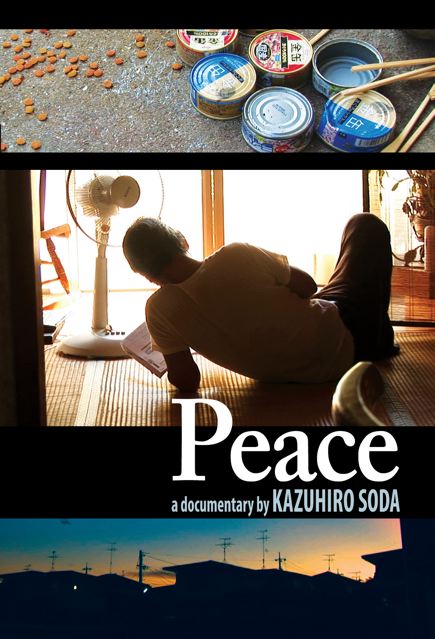
Poster Ideas for PEACE

I'm trying to pick a poster design for PEACE. Any opinions? Design by Yoshio Itagaki.

新作『PEACE』のためのポスター・デザインを決めなくては。どれがいいか迷う!デザインは板垣由雄画伯。

#1
#2
#3
#4

Monday, July 19, 2010

A New Documentary PEACE is now completed!


PEACE, my new documentary is now completed and ready for festivals and distributions.

PEACE is a visual-essay-like observational documentary, which contemplates such questions as "what is peace?" "what is the basis of it?" by observing the daily lives of people and cats in Okayama city, Japan, where life and death, acceptance and rejection are intermingled. One of the main characters of the film is a 91-year-old war veteran Mr. Shiro Hashimoto who is dying of lung cancer. Living in a mice infected small apartment, he is spending his final days, thinking about his own death.

The film was commissioned by DMZ Korean International Documentary Festival, and it will be world-premiered there in September 2010. It is available in HD in two versions - 75 minutes and 53 minutes. All rights are available.

新作映画『PEACE』(観察映画・番外編)が完成した。

本作は、人々や猫たちの、生と死、受容と拒絶が交錯する日常生活を観察しながら、平和について考えるビジュアル・エッセイ風の観察映画。映画の主人公の一人は、橋本至郎氏(91歳)。一人暮らしのアパートで、自らの死を見つめる日々。ひょんなことから、彼の戦争体験が蘇る。

この作品は、国境線の街・韓国のパジュで開かれる非武装地帯ドキュメンタリー映画祭の依頼を受け作られた。9月に開かれる同映画祭でワールド・プレミア上映される予定。撮影地は『精神』と同じ岡山。75分版と53分版がある。

Sunday, July 04, 2010

CAMPAIGN on Netflix

My first feature documentary CAMPAIGN will be available on Netflix if enough number of people "save" the film in their lists. So save it please!

http://bit.ly/99qoJL

Friday, July 02, 2010

『精神』リバイバル限定ロードショー

『選挙』復活ロードショー、東京・新宿や新潟・十日町でまだまだ続行中です。
http://www.laboratoryx.us/campaignjp/index.html

その傍ら、『精神』も東京、大阪、岡山などで7/17(土)からリバイバル限定ロードショーします。7/24にDVDが発売されるので、その記念です。合い言葉「7/24」を劇場窓口で言っていただければ、当日券が一律1000円になります。劇場で映画を体感していただくことを念頭に置いて僕は作品を作っていますので、ぜひこの機会に足を運んでいただけると嬉しいです。上映スケジュール等は、公式サイトで。
http://www.laboratoryx.us/mentaljp/index.php

『精神』DVDは、英語を話す方や聴覚障害のある方に観ていただくため、本編だけですが英語字幕と日本語字幕(岡山弁)を付けました(もちろんオフにもできます)。また、合計80分!にも及ぶ特典映像を収録。山本医師とのロングインタビューや出演者の座談会、岡山初日舞台挨拶、東京初日舞台挨拶、山本医師による青空生き方相談、予告篇が収められています。更に、森達也さんと僕の対談などを収めた解説リーフレットも梱包されています。相当気合いを入れて作ったんですよ〜。

ただいま、アマゾンなどで予約受付中です。
http://www.amazon.co.jp/gp/product/B003JL0HT6/

The re-release of CAMPAIGN is still going on in Tokyo and Niigata.
http://www.laboratoryx.us/campaignjp/index.html

Meanwhile, we're also re-releasing MENTAL in Tokyo, Osaka, and Okayama, starting from July 17th, which commemorates the release of DVD on July 24th. If you say "July 24th" at the box office, your admission will be reduced to 1000 yen. Since I make my films to be seen and to be experienced in movie theaters, please take this opportunity to go and see it. Official website lists the screening schedule (in Japanese).
http://www.laboratoryx.us/mentaljp/index.php

DVD of MENTAL is equipped with English and Japanese subtitles (Okayama-ben) for English speakers and the hearing impaired (the main movie only). It also has 80 minutes of bonus materials which include a long interview of Dr. Yamamoto, a discussion by patients who appeared in the film, the first screening in Okayama and Tokyo, etc... A brochure which includes a discussion between Tatsuya Mori and myself is also included. We spent so much energy and time to produce it!

You can book a copy at amazon etc.
http://www.amazon.co.jp/gp/product/B003JL0HT6/

Tuesday, May 04, 2010

Deleted Scenes of CAMPAIGN 『選挙』未収録シーン

#1 Yama-san makes a speech while school kids are playing.
その1。山さん、ボール遊びをする小学生の傍らで演説敢行。


#2 A dog barks at Yama-san when he's making a speech.
その2。山さん、演説中に犬に吠えられる。


#3 Yama-san takes a picture while maiing a speech.
その3。山さん、演説中に記念写真。


#4 Yama-san forgets to get on the campaign car.
その4。山さん、選挙カーに乗るのを忘れる。


#5 Yama-san's "house wife" Sayuri fights back.
その5。山さん、奥さんに痛いところをつかれる。


#6 Is that handsome Sensei single and available?!
その6。あの先生、独身なんですか?!


#7 Dirty jokes in the morning.
その7。朝から下ネタ全開。